Everything about wall printing: From surface prep to the final effect
1. What exactly is UV wall printing?
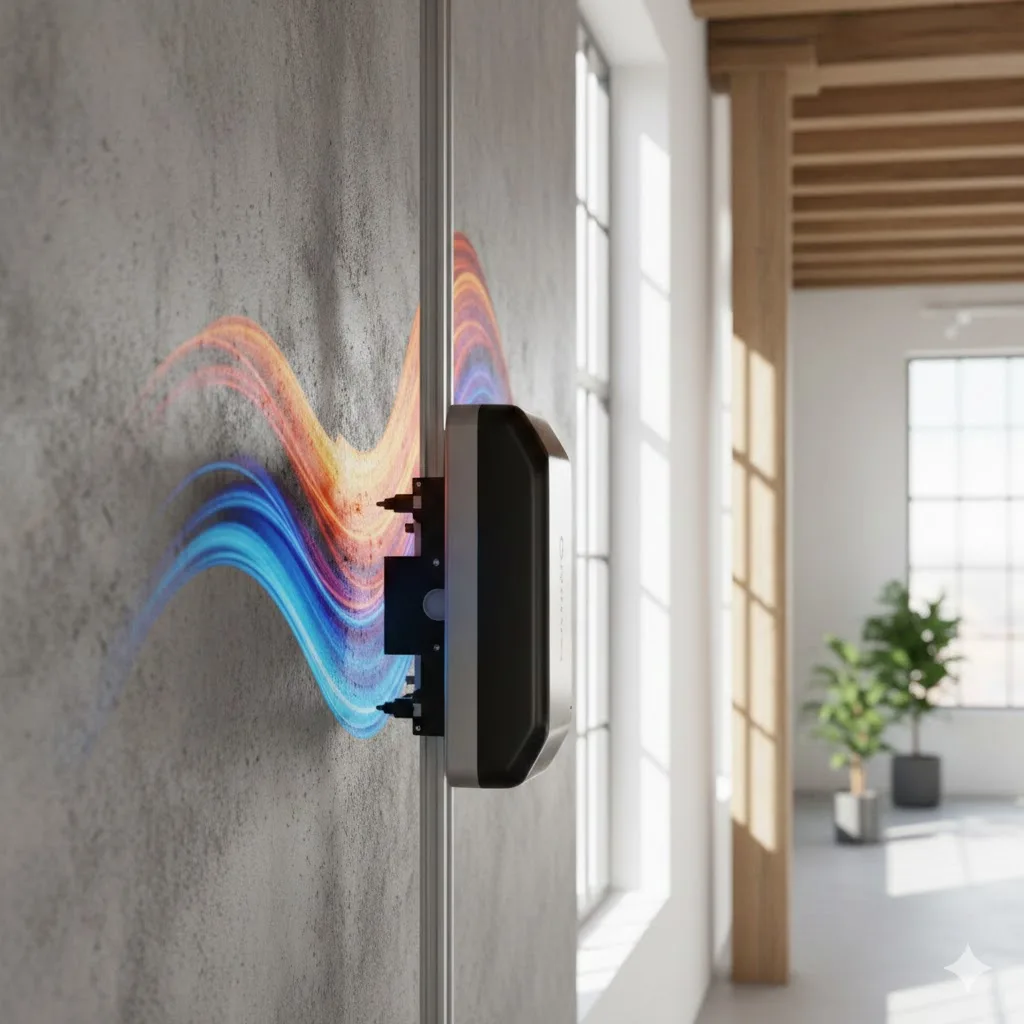
Unlike traditional decoration methods, a wall printer (like our Wall Printer+ Pro) doesn’t stick anything to the wall. It’s a vertical CNC device that moves along the surface and applies microscopic droplets of UV-curable ink.
Each droplet is instantly exposed to a UV lamp with a specific wavelength (typically
365−395 nm
). This triggers immediate photopolymerization - the ink changes from liquid to solid. The result? The print is dry, hard and touch-ready in a fraction of a second.
2. What surfaces can you print on?
This is the biggest advantage of the technology. Thanks to intelligent distance sensors, the machine adapts to the surface texture. We can print on:
List of printable surfaces:
- Plaster and skim coats: Standard walls painted with acrylic or latex.
- Architectural concrete: The print keeps the raw character of the concrete, penetrating its pores.
- Brick and stone: The head “floats” over unevenness, creating a hand-painted mural effect.
- Glass and mirrors: Ideal for offices and bathrooms (requires special degreasing).
- Wood and MDF boards: From natural planks to furniture.
Important note
The surface must be stable. If paint is flaking, the print will come off with it. The printer is precise, but it’s not “glue” for crumbling plaster.
3. How to prepare the wall? (Client checklist)
To make your wall print look perfect, prepare the surface using these points:
-
Cleanliness: The wall must be free of dust, cobwebs and greasy stains (especially in kitchens).
-
Base color: Best results are achieved on white or light walls. We do print with white ink, but a light background boosts color saturation and reduces material usage.
-
Smoothness: You don’t need a mirror-smooth wall, but remove larger plaster bumps or protruding nails. The machine has safety margins, but the more even the wall, the sharper the detail.
-
Access: We need about 1 meter of free space in front of the wall to set up the machine rails.
4. Durability and safety: what you should know
We often hear the question: “What if a child touches the wall with dirty hands?” Our answer: nothing happens.
Durability: UV prints are extremely fade-resistant. Indoors, their lifespan is estimated at over 10 years. The ink doesn’t react with oxygen, so colors stay as vivid as on day one.
Mechanical resistance: Once cured, UV ink forms a thin plastic layer. You can wipe it with a damp cloth and mild detergent. It’s much more scratch-resistant than traditional wall paint.
Ecology: This is a key aspect for MAELL. Our inks are certified for use in kindergartens and hospitals. They emit no odors or harmful substances (VOCs).
5. How long does it take and how much does it cost?
Printing speed
Printing time depends on the quality mode (resolution), the surface type and on-site conditions. On average, we print around 1 m² per hour (standard mode).
Pricing
Prices start from €120 net per m² and are always calculated individually, based on:
- total print area,
- surface type (e.g., glass requires different settings than plaster),
- project location.
Travel / logistics
We work in Poland and across Germany. A logistics fee is added to every project, covering equipment transport and team travel. The fee starts from €70 net per hour of travel time, calculated from our base in Zielona Góra.
Summary
Wall prints are an investment in uniqueness. Whether you want office branding, a wayfinding system for a developer, or a fairy-tale world in a child’s room - UV wall printing gives you certainty no other decoration method can match.
Have a ready idea? Or just a blank wall and no vision? Let’s talk. Send us your wall dimensions and we’ll take care of the rest.